Showing posts with label Universe. Show all posts

Tuesday, July 10, 2012

What is God particle or Higgs boson

 CERN physicists " Finally I've found," said, brings the mass of substance thought 'God particle' or 'Higgs boson', responding to many questions in the scientific world, has brought a lot of questions.
Scientists at the CERN research centre near Geneva, Switzerland, on Wednesday unveiled their latest findings in their search for the Higgs boson, a subatomic particle key to the formation of stars, planets and eventually life after the Big Bang 13.7 billion years ago.
WHAT IS THE HIGGS BOSON?
The Higgs is the last missing piece of the Standard Model, the theory that describes the basic building blocks of the universe. The other 11 particles predicted by the model have been found and finding the Higgs would validate the model. Ruling it out or finding something more exotic would force a rethink on how the universe is put together.
Scientists believe that in the first billionth of a second after the Big Bang, the universe was a gigantic soup of particles racing around at the speed of light without any mass to speak of. It was through their interaction with the Higgs field that they gained mass and eventually formed the universe.
The Higgs field is a theoretical and invisible energy field that pervades the whole cosmos. Some particles, like the photons that make up light, are not affected by it and therefore have no mass. Others find it drags on them as porridge drags on a spoon.
Picture George Clooney (the particle) walking down a street with a gaggle of photographers (the Higgs field) clustered around him. An average guy on the same street (a photon) gets no attention from the paparazzi and gets on with his day. The Higgs particle is the signature of the field - an eyelash of one of the photographers.
The particle is theoretical, first posited in 1964 by six physicists, including Briton Peter Higgs.
The search for it only began in earnest in the 1980s, first in Fermilab's now mothballed Tevatron particle collider near Chicago and later in a similar machine at CERN, but most intensively since 2010 with the start-up of the European centre's Large Hadron Collider.
 
WHAT IS THE STANDARD MODEL? The Standard Model is to physics what the theory of evolution is to biology. It is the best explanation physicists have of how the building blocks of the universe are put together. It describes 12 fundamental particles, governed by four basic forces.
But the universe is a big place and the Standard Model only explains a small part of it. Scientists have spotted a gap between what we can see and what must be out there. That gap must be filled by something we don't fully understand, which they have dubbed 'dark matter'. Galaxies are also hurtling away from each other faster than the forces we know about suggest they should. This gap is filled by 'dark energy'. This poorly understood pair are believed to make up a whopping 96 percent of the mass and energy of the cosmos.
Confirming the Standard Model, or perhaps modifying it, would be a step towards the holy grail of physics - a 'theory of everything' that encompasses dark matter, dark energy and the force of gravity, which the Standard Model also does not explain. It could also shed light on even more esoteric ideas, such as the possibility of parallel universes.
CERN spokesman James Gillies has said that just as Albert Einstein's theories enveloped and built on the work of Isaac Newton, the work being done by the thousands of physicists at CERN has the potential to do the same to Einstein's work.
WHAT IS THE LARGE HADRON COLLIDER? The Large Hadron Collider is the world's biggest and most powerful particle accelerator, a 27-km (17-mile) looped pipe that sits in a tunnel 100 metres underground on the Swiss/French border. It cost 3 billion euros to build.
Two beams of protons are fired in opposite directions around it before smashing into each other to create many millions of particle collisions every second in a recreation of the conditions a fraction of a second after the Big Bang, when the Higgs field is believed to have 'switched on'.
The vast amount of data produced is examined by banks of computers. Of all the trillions of collisions, very few are just right for revealing the Higgs particle. That makes the hunt for the Higgs slow, and progress incremental.
 
WHAT IS THE THRESHOLD FOR PROOF? To claim a discovery, scientists have set themselves a target for certainty that they call "5 sigma". This means that there is a probability of less than one in a million that their conclusions from the data harvested from the particle accelerator are the result of a statistical fluke.
The two teams hunting for the Higgs at CERN, called Atlas and CMS, now have twice the amount of data that allowed them to claim 'tantalising glimpses' of the Higgs at the end of last year and this could push their results beyond that threshold.

Sunday, April 3, 2011

sun position in milky way galaxy


Somewhere between the years 1921-1926, Edwin Hubble, an American astronomer opened the large metal sheet doors to the Mt. Wilson Observatory and beheld the universe.

There he discovered that the clouds of gas swirling in space where in actuality individual galaxies, some much larger than our own. He profoundly changed our understanding of the universe. And gave new understanding to our own galaxy the Milky Way.

That's us right there, within the sunbeam.
Highlighted by a circle. Earth, one small dot.
On September 5th, 1977, Voyager 1 was launched into space. It was to travel to the farthest edge of our galaxy taking numerous pictures along the way. By the request of Carl Sagan an American astronomer, astrophysicist and cosmologist, NASA commanded the Voyager 1 spacecraft, having completed its primary mission and now leaving the Solar System, to turn its camera around and to take a photograph of our solar system across a great expanse of space. On February 14, 1990 now at the edge of our galaxy Voyager 1 turned its cameras around and faced its home.

Thousands of pictures were taken between the months of February to June of 1990 with one picture capturing the hearts and minds of all those who saw it. Taken from nearly 4 billion miles away, a photo of Earth was captured. Surprising even Mr. Sagan, the image of our Earth sat cloaked, surrounded by the darkness of deep space, suspended within a beam of light from our Sun. For some this image struck a chord, begging one to reflect on our creation and raising new questions as to the meaning of our existence. What is our purpose? Are we as a species, a planet, somehow privileged? Is our planetary creation a fluke or an element of creative, intelligent design?

-The mediocrity principle is the notion in philosophy of science that there is nothing special about humans or the Earth. The principle concludes that the Earth is a typical rocky planet in a typical planetary system, located in an unexceptional region of a common galaxy. Hence it is probable that the universe teems with complex life. -Wikipedia

Our planet, how rare are we? Or how common? Without question our planet has won the lottery in terms of conditions and development. Scientists have determined that a chance for planetary creation meeting all the same conditions that we have on Earth equates to 1 in 1,000,000,000,000,000. So how did we get so lucky? There are many factors that lined up just right for our Earth. What are they?

First, our planet is located within the Habitable Zone or otherwise know as the Goldilocks Zone. The habitable zone is the distance from a star where an Earth-like planet can maintain liquid water on its surface and (carbon-based) Earth-like life. Our Earth's position is "just right", not too close to our star the Sun and not too far away. Too close would result in the obvious, an overheated planet, absorbing too much radiation, unable to sustain life. Likewise if our planet was just a little further out it would not absorb enough light and radiation, turning us into our neighboring, frozen, uninhabitable planet, Mars.

Next our Sun known as a G2 star happens to be just the right size for our Earth to orbit properly around. If the Sun was smaller, so would the boundaries of the habitable zone, changing the way the Earth rotated around the Sun. The Earth would have to move closer to the Sun due to a change in its gravitational pull. Earth would likely then have one side facing the Sun while the other side of the planet remained dark and frozen. Our Sun is perfect in size to keep Earth's temperatures in a range necessary for life.

Like a good neighbor, other planets within our solar system look out for our Earth's safety. The larger planets such as Jupiter and Saturn shield Earth from possible asteroid and meteor impacts.


Earth lucked out again by having a faithful companion rotate around it. The moon is Earth's only natural satellite. 1/4 to the size of Earth, the moon remains large enough to resist Earth's gravitational pull, allowing it to aid our planet, stabilizing the Earth's axis.

The moon is also responsible for the tides, which in turn circulates the warm and cold waters of our planet, allowing for seasonal temperatures to sustain complex life.

When it comes to our planet, our Earth's uniqueness is really skin deep. Earth evolved in such a way to have a crust that is just thick enough for stability, yet moveable, with tectonic plates. Tectonic plates are composed of two types of rigid crusts, the continental and oceanic. These are floating on top of the magma interior of the Earth and can move against one another. When two plates collide, one plate can go underneath another.

This process is very important. When microscopic plants in the ocean die, they fall to the bottom of the ocean. Over long periods of time, the remnants of this life, rich in carbon, are carried back into the interior of the Earth and recycled. This pulls carbon out of the atmosphere, which makes sure we don’t get a runaway greenhouse effect, like what happened on Venus. Without the plate tectonics, there’d be no way to recycle this carbon, and the Earth would overheat.

Also, there is the magnetic field within the Earth which assists in protecting the planet from solar wind (a stream of energetic charged particles emanating from the Sun) by deflecting most of the charged particles.

Of course then there is the essential gift to life, water. About 70% of the Earth's surface is covered with water, and most of that is the ocean. Only a small portion of the Earth's water is freshwater, which is found in rivers, lakes, and groundwater. Freshwater is needed for drinking, farming, and washing. In addition to liquid water, water is also present on Earth in the form of ice. Without water, life as we know it would not exist.

78% Oxygen, 21% Nitrogen, 17% Carbon are the ingredients to our Earth's atmosphere. An atmosphere is a layer of gases that surround our planet and are kept in place by Earth's gravity. -The atmosphere protects life on Earth by absorbing ultraviolet solar radiation, warming the surface through heat retention (greenhouse effect), and reducing temperature extremes between day and night.- Wikipedia

So far Earth is the only planet that we know of with this type of infused casing.

I grew up knowing our solar system, every child is introduced to it at some point in a science class. Some even had to create a replica, bent wire coat hangers with attached painted foam planets. As a child I knew Earth's location and its neighboring planets and have kept a mental image of our solar system filed away somewhere in my mind ever since. But our galaxy, that is an image to ponder. And our location within it is equally impressive.


Location, location, location any good realtor will tell you this is what you want to look for. And whether by chance or design, Earth got a prime lot. Location in our solar system, galaxy and universe can mean the difference between the lush, vibrant planet on which we live, and a barren wasteland, devoid of life.


Our solar system is located in the outer reaches of the Milky Way Galaxy, which is a spiral galaxy. The Milky Way Galaxy contains roughly 200 billion stars. Most of these stars are not visible from Earth. Almost everything that we can see in the sky belongs to the Milky Way Galaxy. And like our solar system, the Milky Way also has a habitable zone. It is located in a relatively “quiet” area nestled between two spiral arms.

Our Sun and Earth is located within a small, partial arm that is known as the Orion Arm, or Orion Spur. It is nestled safely between the spirals known as Perseus and Sagittarius. Within the center of our galaxy is a black hole. Luckily we are far enough away from it to dodge the extreme levels of X-ray and gamma radiation that emits from it.

Within the spirals of our galaxy, gases, dust and debris swirl about. Novas and supernovas explode making the spirals a volatile environment to exist within. From our position however, between the spirals, Earth maintains a clear view of the night sky, allowing us to study all that we can see, which in turn allows us to have a better understanding to our own existence.

And finally our Earth maintains a moderate rotation which allows life to exist upon it while its perfectly attuned forces (gravity-electrons-protons-nuclear-etc.) keep all its systems and balances and complex life and ecosystems in check.

There are many more complex reasons the Earth is special compared to its neighbors as well as compelling facts which lend support to the idea that maybe our planet IS the handiwork of intelligent design. But I'm no Carl Sagan, just someone who saw an interesting movie with thought provoking questions.

Somehow I can't help but think of how our planet is floating and swirling within this cosmic cluster of dust, in a sea of darkness and feel a little small. But then I think of all the gifts our planet contains which has enabled it the ability to support life, and I can't help believe that there IS a reason for it all. We must have purpose. I can't think that Earth's creation is a random act, a mere accident, pure chance.

It is true however that our galaxy is one of billions and trillions of galaxies, so certainly then you would have to think that there has to be other planets out there similar to our own. But in the meantime, we are all we know, we are all we have and as far as we know - there is only ONE planet Earth.


Check out this link to see the latest discovery of a new rocky planet made by NASA's space telescope, Kepler. http://www.youtube.com/watch?v=zjwcXd4Toms

Sunday, October 19, 2008

Black holes

There are many popular myths concerning black holes, many of them perpetuated by Hollywood. Television and movies have portrayed them as time-traveling tunnels to another dimension, cosmic vacuum cleaners sucking up everything in sight, and so on. It can be said that black holes are really just the evolutionary end point of massive stars. But somehow, this simple explanation makes them no easier to understand or less mysterious.

NOTE: This section is about what are called "stellar-mass black holes". For information about black holes with the mass of billions of Suns, see Active Galaxies & Quasars .

Black Holes: What Are They?

Black holes are the evolutionary endpoints of stars at least 10 to 15 times as massive as the Sun. If a star that massive or larger undergoes a supernova explosion, it may leave behind a fairly massive burned out stellar remnant. With no outward forces to oppose gravitational forces, the remnant will collapse in on itself. The star eventually collapses to the point of zero volume and infinite density, creating what is known as a " singularity ". As the density increases, the path of light rays emitted from the star are bent and eventually wrapped irrevocably around the star. Any emitted photons are trapped into an orbit by the intense gravitational field; they will never leave it. Because no light escapes after the star reaches this infinite density, it is called a black hole.

But contrary to popular myth, a black hole is not a cosmic vacuum cleaner. If our Sun was suddenly replaced with a black hole of the same mass, the earth's orbit around the Sun would be unchanged. (Of course the Earth's temperature would change, and there would be no solar wind or solar magnetic storms affecting us.) To be "sucked" into a black hole, one has to cross inside the Schwarzschild radius. At this radius, the escape speed is equal to the speed of light, and once light passes through, even it cannot escape.

The Schwarzschild radius can be calculated using the equation for escape speed.

vesc = (2GM/R)1/2
For photons, or objects with no mass, we can substitute c (the speed of light) for Vesc and find the Schwarzschild radius, R, to be
R = 2GM/c2
If the Sun was replaced with a black hole that had the same mass as the Sun, the Schwarzschild radius would be 3 km (compared to the Sun's radius of nearly 700,000 km). Hence the Earth would have to get very close to get sucked into a black hole at the center of our solar system.

If We Can't See Them, How Do We Know They're There?

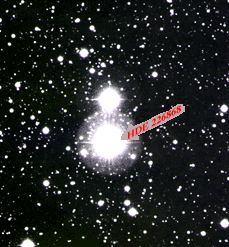
HDE 226868

Since black holes are small (only a few to a few tens of kilometers in size), and light that would allow us to see them cannot escape, a black hole floating alone in space would be hard, if not impossible, to see. For instance, the photograph above shows the optical companion star to the (invisible) black hole candidate Cyg X-1.

However, if a black hole passes through a cloud of interstellar matter, or is close to another "normal" star, the black hole can accrete matter into itself. As the matter falls or is pulled towards the black hole, it gains kinetic energy, heats up and is squeezed by tidal forces. The heating ionizes the atoms, and when the atoms reach a few million degrees Kelvin, they emit X-rays. The X-rays are sent off into space before the matter crosses the Schwarzschild radius and crashes into the singularity. Thus we can see this X-ray emission.

Binary X-ray sources are also places to find strong black hole candidates. A companion star is a perfect source of infalling material for a black hole. A binary system also allows the calculation of the black hole candidate's mass. Once the mass is found, it can be determined if the candidate is a neutron star or a black hole, since neutron stars always have masses of about 1.5 times the mass of the sun. Another sign of the presence of a black hole is random variation of emitted X-rays. The infalling matter that emits X-rays does not fall into the black hole at a steady rate, but rather more sporadically, which causes an observable variation in X-ray intensity. Additionally, if the X-ray source is in a binary system, the X-rays will be periodically cut off as the source is eclipsed by the companion star. When looking for black hole candidates, all these things are taken into account. Many X-ray satellites have scanned the skies for X-ray sources that might be possible black hole candidates.

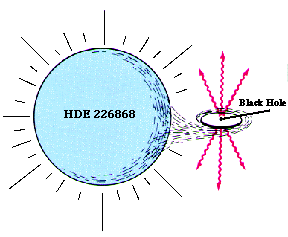
Cygnus X-1 is the longest known of the black hole candidates. It is a highly variable and irregular source with X-ray emission that flickers in hundredths of a second. An object cannot flicker faster than the time required for light to travel across the object. In a hundredth of a second, light travels 3000 kilometers. This is one fourth of Earth's diameter! So the region emitting the x-rays around Cygnus X-1 is rather small. Its companion star, HDE 226868 is a B0 supergiant with a surface temperature of about 31,000 K. Spectroscopic observations show that the spectral lines of HDE 226868 shift back and forth with a period of 5.6 days. From the mass-luminosity relation, the mass of this supergiant is calculated as 30 times the mass of the Sun. Cyg X-1 must have a mass of about 7 solar masses or else it would not exert enough gravitational pull to cause the wobble in the spectral lines of HDE 226868. Since 7 solar masses is too large to be a white dwarf or neutron star, it must be a black hole.

Diagram of Cygnus X-1 system

However, there are arguments against Cyg X-1 being a black hole. HDE 226868 might be undermassive for its spectral type, which would make Cyg X-1 less massive than previously calculated. In addition, uncertainties in the distance to the binary system would also influence mass calculations. All of these uncertainties can make a case for Cyg X-1 having only 3 solar masses, thus allowing for the possibility that it is a neutron star.

Nonetheless, there are now about 10 binaries for which the evidence for a black hole is much stronger than in Cygnus X-1. The first of these, an X-ray transient called A0620-00, was discovered in 1975, and the mass of the compact object was determined in the mid-1980's to be greater than 3.5 solar masses. This very clearly excludes a neutron star, which has a mass near 1.5 solar masses, even allowing for all known theoretical uncertainties. The best case for a black hole is probably V404 Cygni, whose compact star is at least 10 solar masses. With improved instrumentation, the pace of discovery has accelerated over the last five years or so, and the list of dynamically confirmed black hole binaries is growing rapidly.

Black holes

There are many popular myths concerning black holes, many of them perpetuated by Hollywood. Television and movies have portrayed them as time-traveling tunnels to another dimension, cosmic vacuum cleaners sucking up everything in sight, and so on. It can be said that black holes are really just the evolutionary end point of massive stars. But somehow, this simple explanation makes them no easier to understand or less mysterious.

NOTE: This section is about what are called "stellar-mass black holes". For information about black holes with the mass of billions of Suns, see Active Galaxies & Quasars .

Black Holes: What Are They?

Black holes are the evolutionary endpoints of stars at least 10 to 15 times as massive as the Sun. If a star that massive or larger undergoes a supernova explosion, it may leave behind a fairly massive burned out stellar remnant. With no outward forces to oppose gravitational forces, the remnant will collapse in on itself. The star eventually collapses to the point of zero volume and infinite density, creating what is known as a " singularity ". As the density increases, the path of light rays emitted from the star are bent and eventually wrapped irrevocably around the star. Any emitted photons are trapped into an orbit by the intense gravitational field; they will never leave it. Because no light escapes after the star reaches this infinite density, it is called a black hole.

But contrary to popular myth, a black hole is not a cosmic vacuum cleaner. If our Sun was suddenly replaced with a black hole of the same mass, the earth's orbit around the Sun would be unchanged. (Of course the Earth's temperature would change, and there would be no solar wind or solar magnetic storms affecting us.) To be "sucked" into a black hole, one has to cross inside the Schwarzschild radius. At this radius, the escape speed is equal to the speed of light, and once light passes through, even it cannot escape.

The Schwarzschild radius can be calculated using the equation for escape speed.

vesc = (2GM/R)1/2
For photons, or objects with no mass, we can substitute c (the speed of light) for Vesc and find the Schwarzschild radius, R, to be
R = 2GM/c2
If the Sun was replaced with a black hole that had the same mass as the Sun, the Schwarzschild radius would be 3 km (compared to the Sun's radius of nearly 700,000 km). Hence the Earth would have to get very close to get sucked into a black hole at the center of our solar system.

If We Can't See Them, How Do We Know They're There?

HDE 226868

Since black holes are small (only a few to a few tens of kilometers in size), and light that would allow us to see them cannot escape, a black hole floating alone in space would be hard, if not impossible, to see. For instance, the photograph above shows the optical companion star to the (invisible) black hole candidate Cyg X-1.

However, if a black hole passes through a cloud of interstellar matter, or is close to another "normal" star, the black hole can accrete matter into itself. As the matter falls or is pulled towards the black hole, it gains kinetic energy, heats up and is squeezed by tidal forces. The heating ionizes the atoms, and when the atoms reach a few million degrees Kelvin, they emit X-rays. The X-rays are sent off into space before the matter crosses the Schwarzschild radius and crashes into the singularity. Thus we can see this X-ray emission.

Binary X-ray sources are also places to find strong black hole candidates. A companion star is a perfect source of infalling material for a black hole. A binary system also allows the calculation of the black hole candidate's mass. Once the mass is found, it can be determined if the candidate is a neutron star or a black hole, since neutron stars always have masses of about 1.5 times the mass of the sun. Another sign of the presence of a black hole is random variation of emitted X-rays. The infalling matter that emits X-rays does not fall into the black hole at a steady rate, but rather more sporadically, which causes an observable variation in X-ray intensity. Additionally, if the X-ray source is in a binary system, the X-rays will be periodically cut off as the source is eclipsed by the companion star. When looking for black hole candidates, all these things are taken into account. Many X-ray satellites have scanned the skies for X-ray sources that might be possible black hole candidates.

Cygnus X-1 is the longest known of the black hole candidates. It is a highly variable and irregular source with X-ray emission that flickers in hundredths of a second. An object cannot flicker faster than the time required for light to travel across the object. In a hundredth of a second, light travels 3000 kilometers. This is one fourth of Earth's diameter! So the region emitting the x-rays around Cygnus X-1 is rather small. Its companion star, HDE 226868 is a B0 supergiant with a surface temperature of about 31,000 K. Spectroscopic observations show that the spectral lines of HDE 226868 shift back and forth with a period of 5.6 days. From the mass-luminosity relation, the mass of this supergiant is calculated as 30 times the mass of the Sun. Cyg X-1 must have a mass of about 7 solar masses or else it would not exert enough gravitational pull to cause the wobble in the spectral lines of HDE 226868. Since 7 solar masses is too large to be a white dwarf or neutron star, it must be a black hole.

Diagram of Cygnus X-1 system

However, there are arguments against Cyg X-1 being a black hole. HDE 226868 might be undermassive for its spectral type, which would make Cyg X-1 less massive than previously calculated. In addition, uncertainties in the distance to the binary system would also influence mass calculations. All of these uncertainties can make a case for Cyg X-1 having only 3 solar masses, thus allowing for the possibility that it is a neutron star.

Nonetheless, there are now about 10 binaries for which the evidence for a black hole is much stronger than in Cygnus X-1. The first of these, an X-ray transient called A0620-00, was discovered in 1975, and the mass of the compact object was determined in the mid-1980's to be greater than 3.5 solar masses. This very clearly excludes a neutron star, which has a mass near 1.5 solar masses, even allowing for all known theoretical uncertainties. The best case for a black hole is probably V404 Cygni, whose compact star is at least 10 solar masses. With improved instrumentation, the pace of discovery has accelerated over the last five years or so, and the list of dynamically confirmed black hole binaries is growing rapidly.